

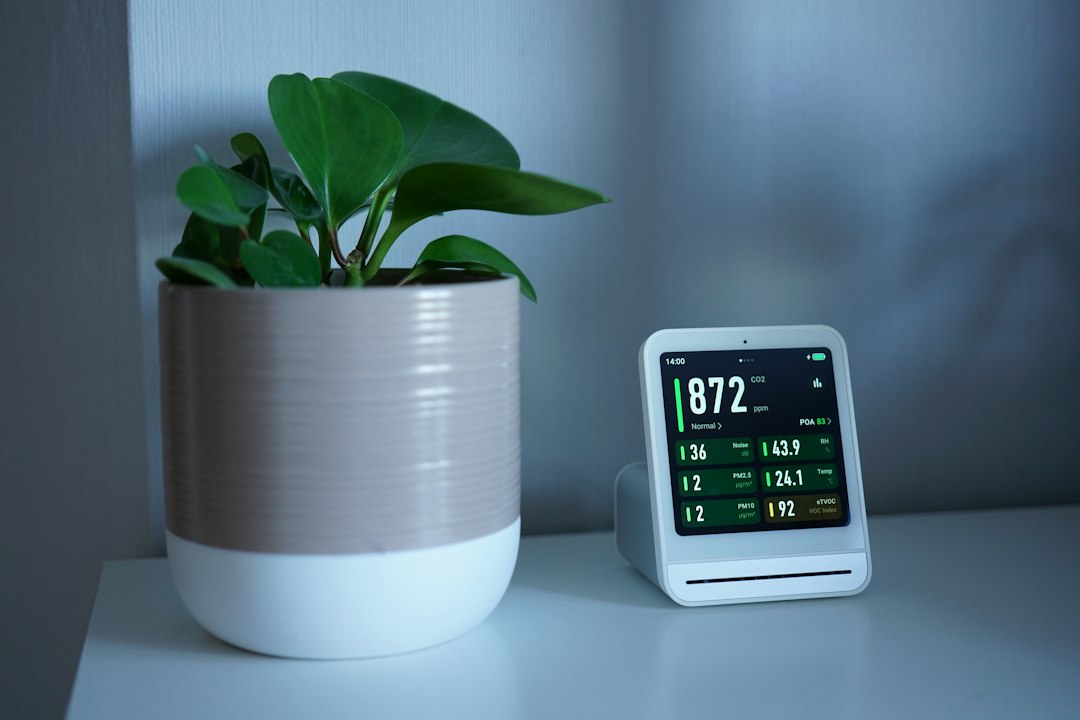
Carbon dioxide (CO₂) measurements can be useful during an indoor air quality (IAQ) investigation, particularly in occupied offices, schools, and meeting rooms. Yet a CO₂ reading is not a direct measurement of outdoor-air ventilation, an overall air-quality score, or proof that a building is safe or unsafe. The most defensible interpretation combines instrument readings with occupancy, operating conditions, and a review of the ventilation system.
Why measure indoor carbon dioxide?
People exhale CO₂. In an occupied room, its concentration reflects a changing balance among the number and activity of occupants, outdoor-air delivery, room volume, air mixing, and time. A rising trend may prompt investigation of outdoor-air supply relative to occupancy. A low reading in an empty office, however, provides little information about performance when the room is full.
The CDC/NIOSH ventilation guidance describes portable CO₂ monitoring as one tool for examining building ventilation, provided reliable meters and representative measurements are used. Monitoring complements—not replaces—verification that the HVAC system delivers the required outdoor air.

A practical CO₂ measurement approach
- Review the space. Record room use, approximate floor area, occupant count, occupancy schedule, supply and return locations, and whether windows or doors are normally open.
- Check the instrument. Use a reliable, appropriately calibrated CO₂ meter; review its specifications, calibration or verification information, and response time. A consumer display alone does not establish measurement accuracy.
- Collect representative readings. Measure near the occupied breathing zone, away from direct exhalation, open windows, supply diffusers, and obvious localized CO₂ sources. Allow the meter to stabilize and document measurement times.
- Establish outdoor conditions. Measure outdoor CO₂ where practicable and consider the indoor–outdoor difference. Record whether the building is occupied and the HVAC system is operating normally.
- Look for patterns. Repeated measurements or logging across the workday can reveal occupancy-related peaks that a single spot reading would miss.
The EPA’s building IAQ guidance emphasizes recording occupancy and ventilation conditions and avoiding sampling locations directly affected by a person’s breath.
Interpreting measurements without a misleading cutoff
A commonly repeated claim is that indoor CO₂ above 1,000 parts per million (ppm) automatically violates an ASHRAE standard. That is incorrect. Research published by the National Institute of Standards and Technology (NIST) explains why 1,000 ppm is not a universal indoor-air-quality limit under ASHRAE Standard 62.1. The currently published ANSI/ASHRAE Standard 62.1-2025 addresses ventilation requirements and system practices, not a blanket CO₂ pass/fail value.
CDC/NIOSH discusses below 800 ppm as one possible starting target in some situations, while explicitly warning that a single target is not appropriate for every room or occupancy. Concentrations should therefore be interpreted in context, not converted automatically into regulatory findings.
| Observation | Reasonable next step |
|---|---|
| CO₂ rises during a crowded meeting | Document occupancy and HVAC operation; assess outdoor-air delivery if warranted. |
| CO₂ is low in an unoccupied room | Repeat under normal occupancy before drawing conclusions. |
| Readings differ between similar rooms | Compare schedules, ventilation zones, sensor locations, and air mixing. |
| CO₂ falls after an HVAC adjustment | Document changed conditions; independently confirm actual airflow where needed. |
What CO₂ monitoring cannot establish
CO₂ data cannot identify volatile organic compounds, carbon monoxide, airborne particles, mold contamination, or a specific source of occupant symptoms. A room with low CO₂ may still contain significant pollutants from cleaning products, combustion, moisture-damaged materials, or outdoor infiltration. Likewise, CO₂ cannot by itself quantify infection risk or demonstrate the effectiveness of particle filtration. The EPA’s guidance on low-cost indoor monitors cautions against drawing health conclusions solely from sensor readings.
When additional investigation is warranted
If observations suggest a ventilation deficiency, the next step may involve checking outside-air dampers, schedules, economizer controls, supply and return airflow, maintenance records, or air balancing. When the concern involves chemical odors, particulate matter, dampness, or a particular workplace substance, use a separate source-specific investigation and appropriate sampling methods. CO₂ screening should never be presented as a substitute for contaminant exposure assessment.
A sound report identifies the instrument, sampling locations, duration, occupancy, HVAC settings, outdoor conditions, uncertainties, and limitations. It separates observed concentrations from interpretations, and recommendations from verified defects. This makes the findings reproducible and useful to facilities and safety professionals.
Technical perspective: Stuart D Bagley, MS, CIH, CSP, IAQ-EMF Consulting Inc. Related project inquiries may be directed through the IndoorAirSite contact page.
Recent Comments